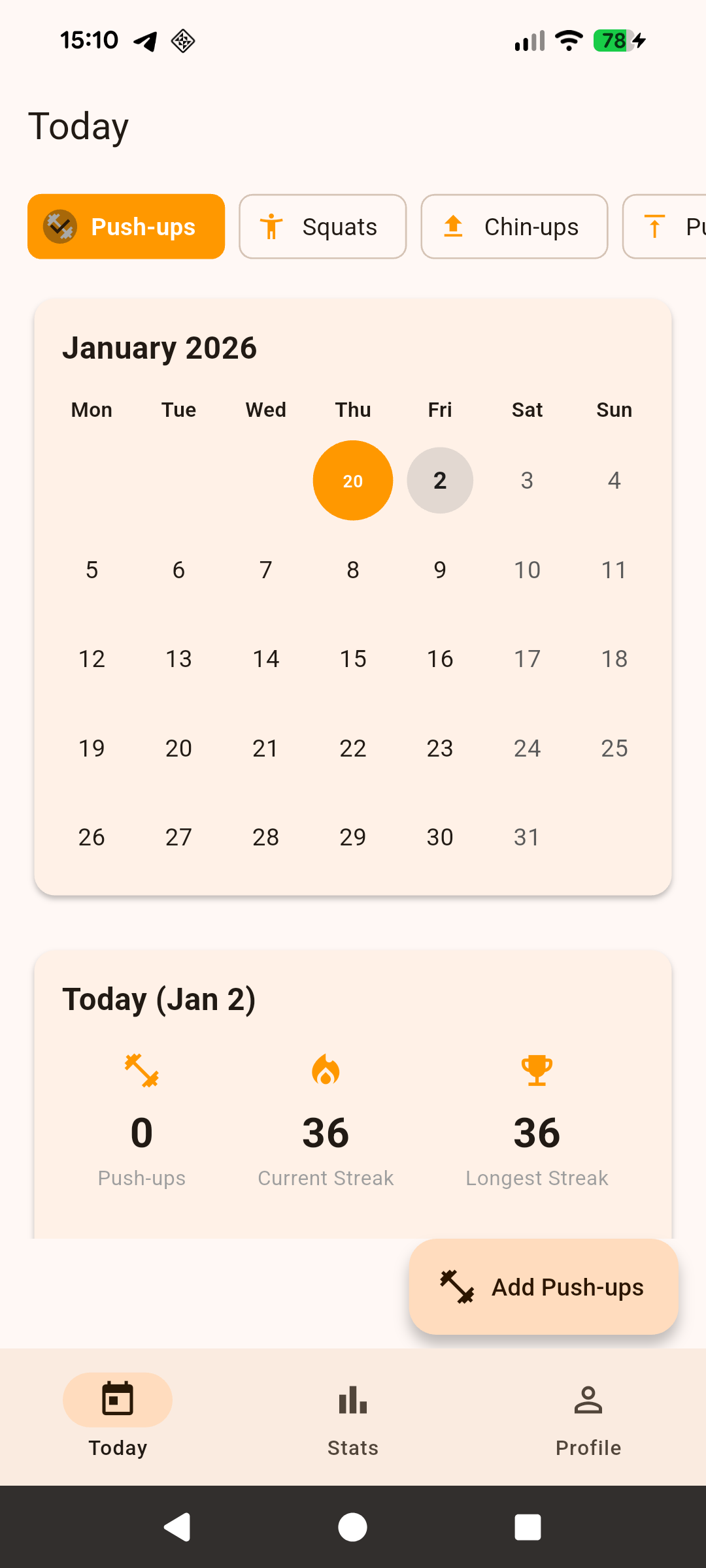
10 squats a day. Logged in 2 seconds. Watch the streak grow. StreakUp is the free squat app for anyone who wants legs that show up — and a body that keeps moving.

A squat is a fundamental lower-body movement: stand with feet shoulder-width apart, then sit your hips back and down until your thighs are parallel to the floor, and stand back up. It works the quads, glutes, hamstrings, and core — the largest muscles in the body. No weights needed to start.
100 squats a day sounds doable. Until day 5, when your legs are screaming and you skip 'just one day' — then never come back. StreakUp's daily minimum can be a single squat. The point isn't volume — it's protecting the chain.
The squat is how your body sits down, picks things up, and stands from a chair. Doing it daily, even at low volume, keeps the hip and knee joints mobile, the glutes active, and your posture upright. The benefits show up in walking, in stairs, in everything.
10 squats a day is 70 a week. 280 a month. 3,360 a year. Most gym-goers never hit that volume on their leg days. StreakUp's long-term stats show you every single rep — proof that small daily deposits add up to serious strength.
Air squats only. Focus on full depth, knees out, heels planted. Even 5 squats a day builds the habit. Goal: 20 clean reps before adding anything.
Add tempo: 3 seconds down, 1-second pause at the bottom, drive up. Start mixing in goblet squats with a dumbbell or backpack. Volume becomes meaningful here.
Move to single-leg variations: split squats, Bulgarian split squats, pistol squat progressions. Or load up — goblet squats with 20kg, sandbag squats, weighted vest air squats.
If your knees collapse toward each other on the way up, your glutes aren't firing. Cue: 'spread the floor with your feet' — actively push your knees out in line with your toes.
Heels coming up means tight ankles or pushing through the toes. Stay flat-footed, drive through the heels. If ankle mobility is the issue, elevate your heels on a small plate or wedge.
A real squat means hip crease below knee level. Quarter-squats build ego, not glutes. If you can't hit depth without tipping forward, your mobility needs work — squat to a chair and let it touch.
Bar squat or air squat, the torso should stay upright-ish. Excessive forward lean shifts work to the lower back. Keep your chest tall and look slightly forward — not down.
Body-weight only. Focus on full depth.
Add a 1-second pause at the bottom.
Slow tempo: 3 seconds down.
You can split into 2 sets across the day.
Yes — completely free on Android and iOS. No paywall, no premium tier, no subscription. The full app, including squat tracking, is yours from day one.
Tap the squat exercise, enter the number of reps you just did, and confirm. The whole flow takes about 2 seconds. Log multiple sets per day — they roll into your daily total.
Air squats are one of the safest exercises in the human movement library — your body is designed for them. Daily air squats, even at higher volume, are well-tolerated by healthy adults. Add load (dumbbells, barbell) only after mastering the body-weight version with full depth.
Start with 5–10 air squats per day. You're not training for performance — you're training the habit. Once 10 feels easy, bump to 15. Most beginners can hit 30+ reps comfortably within a month of daily practice.
Air squats build leg endurance and muscle in beginners and intermediates. To keep growing once you're past ~50 reps, you'll need to add load (weighted vest, dumbbells, sandbag) or progress to harder variations like split squats, jump squats, or pistol squats.
Yes — StreakUp gives each exercise its own independent streak, calendar, and stats. You can run a 90-day squat streak and a 30-day push-up streak simultaneously, without one affecting the other.