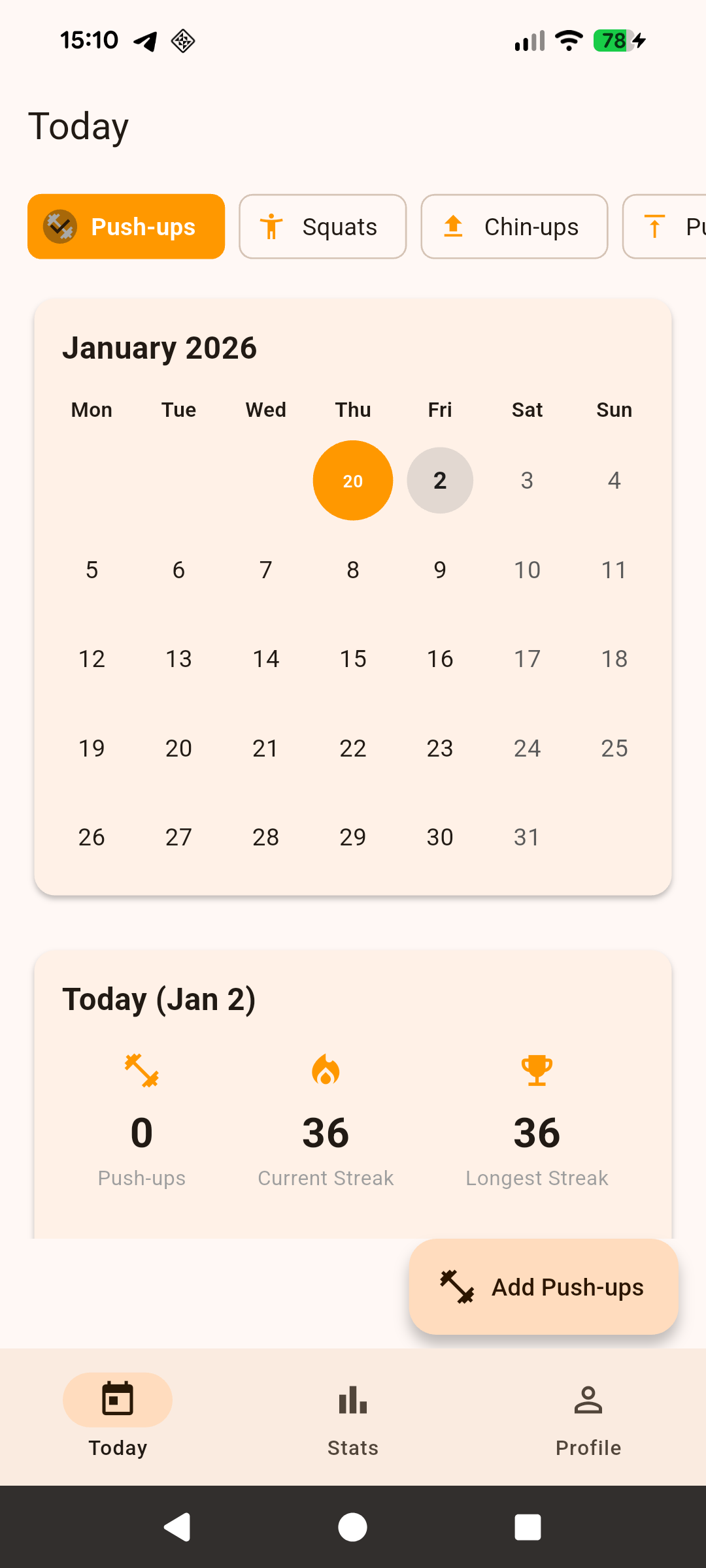
10 leg raises a day, logged in 2 seconds. Watch the streak grow. StreakUp is the free leg raise app for anyone serious about a strong, stable, visible midsection.

A leg raise is a core exercise: lie flat on your back (or hang from a bar) and raise straight legs to vertical, then lower under control. It targets the lower abs, hip flexors, and stabilizing core — the muscles most other ab exercises miss. The best bodyweight movement for the lower abdominal block.
Crunches one day, planks the next, nothing the day after. The result: no visible progress. StreakUp ties one core exercise — leg raises — to a daily streak. The volume compounds; the abs respond to the volume.
Sit-ups and crunches mostly work the upper abs. The lower abs — the part that frames a six-pack — barely engages. Leg raises invert that. Daily reps build the bottom half of the abdominal wall that other movements ignore.
A strong core is what keeps the lower back happy. Daily leg raises strengthen the muscles that prevent the chronic anterior pelvic tilt most desk workers develop. The aesthetic benefit is a side effect of the postural one.
Start with bent-knee raises lying flat. Goal: 10 clean reps with the lower back glued to the floor. Don't worry about straight legs yet — control matters more than range.
Straight-leg raises lying flat. Add a pause at the top (legs vertical) for 1 second. Once 20+ reps feel easy, switch the surface — raises off a bench let the legs go below horizontal for more range.
Move to hanging leg raises from a pull-up bar. Start with knee raises, then straight-leg. Final progression: toes-to-bar. This is where the V-shaped lower abdominal cut shows up.
If your lumbar spine peels off the floor during a lying leg raise, you've overshot the bottom — the hip flexors are taking over. Press the lower back into the floor at all times. Reduce range if needed; quality beats range.
If your legs swing like a pendulum, you're using elastic energy, not muscle. Pause at the top, pause at the bottom (without the heels touching), and control the descent for at least 2 seconds.
Bent-knee raises are a regression, not the standard. They're fine when starting out, but once you can do 15+, straighten the legs — the lever arm doubles the load on the lower abs without adding any equipment.
Exhale on the way up (legs to vertical), inhale on the way down. Holding the breath spikes intra-abdominal pressure and makes the rep feel twice as hard.
Lower back flat on the floor at all times.
Add a 1-second hold at the top.
Slow down: 2 seconds up, 2 seconds down.
Mix in 5 hanging knee raises if you have a bar.
Yes — completely free on Android and iOS. No paywall, no premium tier, no subscription. The full app, including leg raises with its own streak and stats, is yours from day one.
Tap the leg raise exercise, enter the reps you just did, and confirm. The whole flow is about 2 seconds. Log multiple sets per day — they roll into your daily total.
For the lower abs, yes — leg raises engage the part of the abdominal wall that crunches barely touch. For the upper abs, crunches still have a place. Most well-rounded ab work uses both, but if you had to pick one, leg raises hit more of the muscle.
Visible abs come from low body fat (a kitchen problem) and developed abdominal muscle (a training problem). Daily leg raises solve the second half — they build the muscle. To actually see it, you also need to keep body fat low enough.
Yes. The abs recover quickly from moderate-volume bodyweight work — daily exposure of 10–30 reps is well within most adults' recovery. If you're sore for 48+ hours, drop volume but keep the daily check-in.
Lying leg raises on the floor work just as well for the lower abs, especially for beginners and intermediates. The hanging version is harder because gravity pulls the legs further from the body — but you can build a serious core entirely on the floor.